March 13, 2026

Buildings up to 100' wide and 24' high now available.
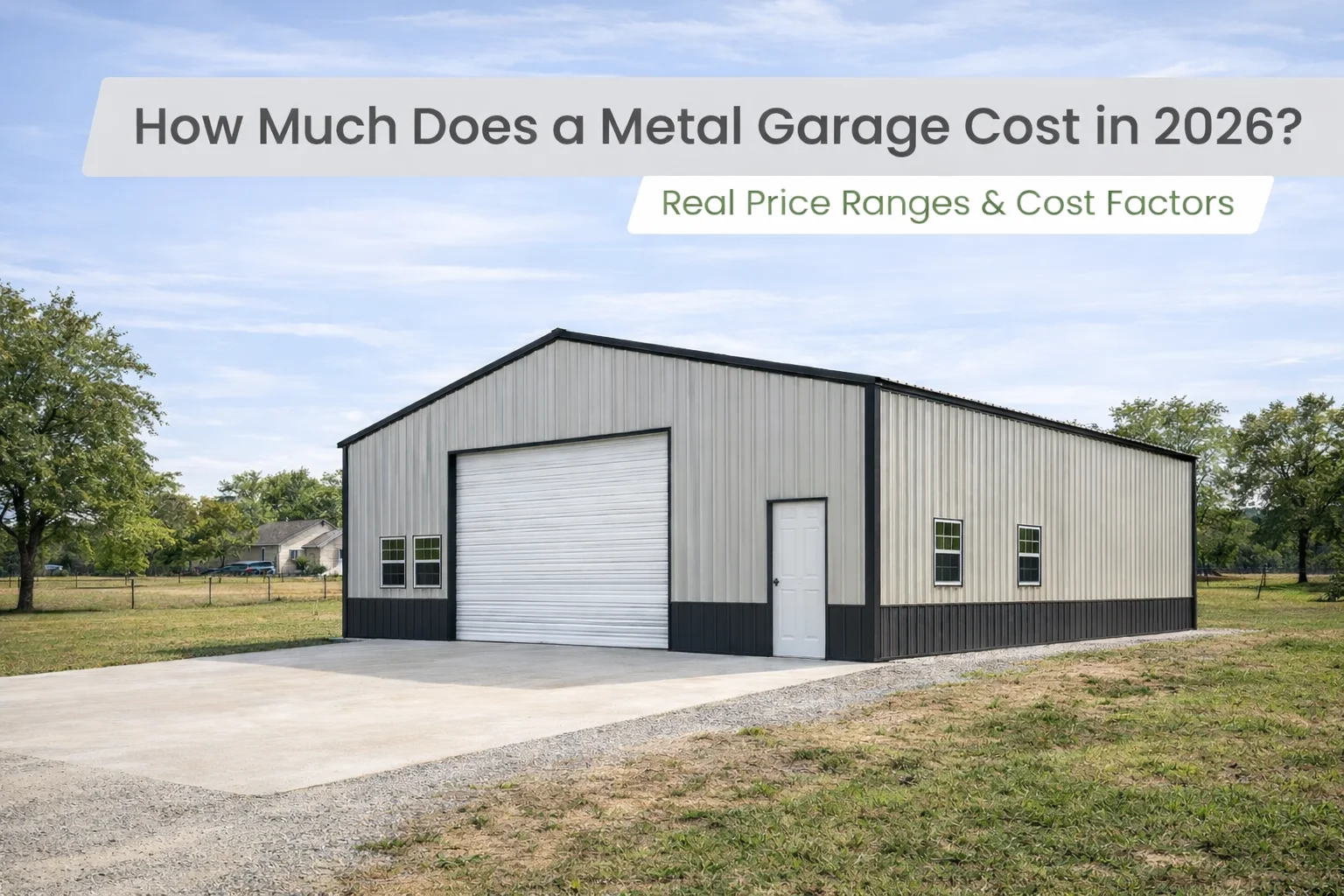
Metal garages cost $6,999–$52,000+ delivered and installed, depending on size, roof style, and your state’s engineering requirements.
Most common sizes — installed prices:
* 2-car garage (24×24): starts at $9,786
* 30×40 workshop: starts at $15,401
* 50×60 commercial: starts at $52,045
Per square foot: $11–$20 for the structure, delivered and installed.
Included: Delivery + professional installation + standard anchors.
Not included: Concrete slab, permits, site grading, electrical.
Steel prices dropped roughly 8% from their 2022 peak. 2026 quotes are lower than what buyers saw two years ago.
If you’ve searched for metal garage prices and gotten ranges like “$5,000–$50,000,” that’s not a price — that’s a refusal to answer. A 10×20 open carport in a mild climate and a 40×60 insulated commercial shop in a Florida wind zone aren’t the same product. Lumping them together doesn’t help you budget.
This guide gives you actual prices from real orders — broken down by size, roof style, add-ons, and state. It also covers what most buyers forget to budget for, which is usually the thing that blows the project.
One thing worth understanding before you start comparing quotes: metal building prices vary by region not just because of delivery distance, but because of local engineering requirements. A building certified for a Florida hurricane zone costs more than the same structure built for a Kansas farm. That difference shows up in the quote — or it shows up later as a failed inspection. Either way, it’s real money.
These prices reflect current 2026 pricing for steel garages delivered and installed in the continental US. Prices shown are starting points for standard configurations — vertical roof, standard leg height, no add-ons. Your final quote will depend on roof style choice, add-ons, and your state’s engineering requirements.
| Size & Common Use | Starting Price (Installed) | Per Sq Ft (approx.) |
|---|---|---|
| 12×20 (1-car compact) | $6,999 | ~$29/sqft |
| 18×20 (1-car standard) | $7,845 | ~$22/sqft |
| 20×20 (1-car wide) | $8,400 | ~$21/sqft |
| 24×24 (2-car standard) | $9,786 | ~$17/sqft |
| 24×30 (2-car + depth) | $11,817 | ~$16/sqft |
| 24×30 (enclosed storage) | $12,549 | ~$17/sqft |
| 30×40 (workshop / 3-car) | $15,401 | ~$13/sqft |
| 30×50 (auto workshop) | $24,300 | ~$16/sqft |
| 50×60 (commercial / farm) | $52,045 | ~$17/sqft |
* All prices include delivery and professional installation in the continental US. Does not include concrete slab, permit fees, site grading, or electrical. Prices are starting points — add-ons and regional engineering requirements affect the final number.
A 12×20 at $6,999 works out to about $29/sqft. A 30×40 at $15,401 is about $13/sqft. The reason is fixed costs — delivery, installation labor, and the basic structural components don’t scale down proportionally with building size. The larger the footprint, the more efficient the cost per square foot becomes.
Practical implication: if you’re deciding between a 24×30 and a 30×40, the per-sqft difference narrows significantly. The extra 240 square feet often costs less than buyers expect — and most people who hesitate on the upgrade wish they’d gone bigger.
Roof style is the second-biggest pricing variable after size. It also has the biggest impact on how the building performs over time. Here’s an honest breakdown of all three — including when the cheaper option is genuinely fine and when it isn’t.
Horizontal panels with a rounded ridge. This is the entry-level option and the starting price in most size quotes. It works reliably in areas with low annual precipitation, minimal snow, and no sustained high winds.
Where it underperforms: anywhere that gets significant snow or heavy seasonal rain. The horizontal seams are the vulnerability — water and snow sit in them rather than shedding off. Over time, seam corrosion is the most common failure point on regular roof buildings.
Honest take: if you’re in central Texas, Southern California, or a similar dry climate and primarily storing equipment or vehicles, a regular roof is genuinely appropriate. Don’t pay to upgrade if you don’t need to.
The A-frame pitch that matches a conventional house roofline. The panels are still horizontal, which means the seam vulnerability is the same as a regular roof — just with better curb appeal. The drainage improvement is minimal.
This is the right choice if you’re in a neighborhood with aesthetic requirements, or if you simply want the building to look more residential. It’s not a meaningful performance upgrade over a regular roof for weather resistance.
Panels run top-to-bottom instead of side-to-side. Rain, snow, leaves, and debris shed off the face of the panel rather than accumulating in horizontal seams. This is the roof style that holds up in actual weather.
It’s required — not just recommended — in Florida and most coastal wind zones. Even in states where it’s optional, it’s what experienced buyers choose when they’re not under budget pressure. The longevity difference over a regular roof in a four-season climate is significant enough that the math usually favors paying the premium.
On a 30×40, the price difference between a regular roof and a vertical roof is approximately $4,600–$5,600. In Ohio, Pennsylvania, the Carolinas, or anywhere with a real winter, that premium will return itself in avoided repairs long before the building’s 20-year warranty expires.
| Roof Style | Panel Direction | Best Climate | Cost vs. Base |
|---|---|---|---|
| Regular Roof | Horizontal | Mild / dry | Base price |
| Horizontal (A-Frame) | Horizontal | Moderate / suburban | +$800–$1,800 |
| Vertical Roof | Vertical | All climates | +$1,600–$3,000 |
The base quote covers the steel structure, delivery, and installation. These are the most common additions and what they typically add to the invoice:
| Add-On | Typical Price Range | Notes |
|---|---|---|
| Walk-in door (36″ steel) | $250–$400 each | Standard recommendation: at least one minimum |
| Window (29″×29″ fixed) | $180–$280 each | Two per side wall is most common |
| Garage door opening (framed) | $350–$600 each | Opening only — door not included |
| Roll-up door 9×7 | $650–$950 installed | Standard single-car opening |
| Roll-up door 10×10 | $850–$1,250 installed | Standard large single or 2-car |
| Double Bubble insulation | $0.50–$2.20 per sqft | ~$1,370–$6,028 for a 30×40 |
| Anchors / auger anchors | $250–$600 | Required by most counties — not optional |
| Engineering certification | $400–$900 | Required in some counties to pull a permit |
| Extra leg height (+2 ft) | $600–$1,400 | For tall trucks, RVs, boats |
| Custom color (non-standard) | $0–$500 | Standard 14 colors included free |
| Open lean-to addition | $3,500–$9,000+ | Covered side extension, popular on farm buildings |
| Enclosed lean-to | $5,500–$14,000+ | Fully walled — effectively extends the building |
A delivered-and-installed quote covers the steel building. It does not cover the ground it sits on.
Concrete slab cost: $8–$10 per square foot for a standard 4-inch reinforced slab. A 30×40 slab: $9,600–$12,000. A 24×24 slab: $4,608–$5,760.
This is consistently the line item that breaks budgets. Buyers plan $16,000 for a 30×40 garage and forget they need another $10,000–$12,000 for the foundation.
Rule of thumb: budget the slab before you budget the building. It’s the first thing that goes in and the most common planning oversight.
Two identical 30×40 buildings with identical specs can cost different amounts depending on where they’re installed. The reason is engineering certification — every state, and in many cases every county, has specific requirements for wind load, snow load, and in some areas seismic resistance.
A building certified for Florida’s wind zones requires different steel gauges, anchor specifications, and a stamped engineering package that a standard Ohio build doesn’t need. That difference is real and it shows up in the quote. Any dealer who quotes a flat national price without asking your zip code is either padding the number to cover every scenario or ignoring the engineering entirely. Both are problems.
| State / Region | Primary Code Requirement | Typical Added Cost |
|---|---|---|
| Florida (south) | 140+ mph wind, Miami-Dade certification | +$800–$2,500 |
| Florida (panhandle/central) | 110–130 mph wind zones | +$400–$1,200 |
| Coastal Texas | 130+ mph wind, elevated anchor specs | +$600–$1,800 |
| Gulf Coast (AL, MS, LA) | Wind zone + salt-air coating recommended | +$700–$2,000 |
| Carolinas (coastal) | Wind zone II/III, engineered anchor systems | +$400–$1,200 |
| Northeast (PA, NY, MA, ME) | Heavy snow load 40–60 psf | +$500–$1,500 |
| Mountain West (CO, WY, MT) | Snow load + occasional seismic overlap | +$600–$1,800 |
| Pacific NW (WA, OR) | Snow load + seismic in some counties | +$500–$1,400 |
| Midwest (OH, IN, IL, MO) | Standard codes — minimal engineering add-on | $0–$400 |
| Central / Plains states | Standard codes — base pricing applies | $0–$300 |
Important: Florida is not uniform. Miami-Dade County has significantly stricter requirements than the Panhandle. If a dealer quotes you a Florida price without specifying your wind zone, ask explicitly. A building that can’t be permitted after delivery isn’t worth the lower headline number.
Practical note for buyers: the easiest way to avoid engineering surprises is to provide your zip code at the time of quote, not after. Any reputable dealer should be pulling local code requirements before generating a number.
A delivered-and-installed metal garage quote covers the steel structure and labor. Everything below is budgeted separately. These are consistent costs regardless of which dealer you buy from:
This is the most commonly underestimated line item in a metal building project. At $8–$10/sqft for a standard 4-inch reinforced slab, a 30×40 foundation runs $9,600–$12,000 before any site prep. Buyers in areas with expansive soils may need thicker slabs with more reinforcement, pushing costs higher.
Some buyers use existing gravel pads for storage buildings and seasonal equipment. That works in low-stakes applications. For any building used as a workshop, for vehicles you care about, or for year-round occupancy, a concrete slab is worth doing properly. Gravel shifts over time and uneven floors cause door alignment problems within a few seasons.
Permit requirements vary dramatically by county. Some rural counties in Tennessee, Kentucky, and the plains states have no permit requirement for structures under a certain square footage. Some counties in California require stamped engineering drawings, a site plan, and a soil report before issuing a permit for a metal building.
Check your county’s requirements before you order — not after. Most building departments have this information online or will answer a phone call. The cost is predictable once you know what’s required; the surprise comes from not checking.
Installation crews work on prepared, level sites. Minor grading on a nearly-flat lot runs $500–$800. Significant slope work — cutting into a hillside, bringing in fill, compacting — can reach $2,000–$3,000 or more depending on how much earth moves.
A crew can install on minor slopes with footer adjustments, but anything beyond 6–8 inches of grade change across the building footprint typically requires prep work before installation day.
Running power to a detached garage is a licensed electrician job. The main variables are distance from the home’s main panel and whether you need a subpanel in the garage. A 50-foot underground run for a basic circuit is a half-day job. A 200-foot run with a 100-amp subpanel is a full day — and the price difference reflects it.
Building: $9,786
Concrete slab: $4,608–$5,760 (24×24 @ $8–10/sqft)
Permit: ~$200
Total estimate: $14,594–$15,746
Building: $15,401
Insulation: $2,500
Slab: $9,600–$12,000
Permit: ~$350
Electrical: ~$1,500
Total estimate: $29,351–$31,751
Building: $15,401
Wind engineering upgrade: $1,200
Slab: $9,600–$12,000
Permit: ~$450
Total estimate: $26,651–$29,051
The comparison changed meaningfully in 2024–2025 and hasn’t reversed. Lumber prices were pushed higher by tariffs and haven’t fully corrected. A contractor-built 30×40 wood workshop — framed, sheathed, roofed, and sided — currently runs $35,000–$55,000 for the structure, before the slab. That’s the same footprint as a steel garage starting at $15,401 installed.
The gap is $20,000–$40,000 for the same square footage. Steel also doesn’t rot, doesn’t attract termites, doesn’t require repainting on a 5–7 year cycle, and carries a 20-year rust-through warranty. Wood outperforms steel on insulation R-value (relevant if you’re heating the space year-round) and on certain aesthetics. But on cost and maintenance over 15 years, steel is not competitive — it wins by a significant margin in most use cases.
Full comparison: Steel Garage vs. Wood Garage: An Honest 2026 Breakdown
Most metal building dealers offer financing and rent-to-own programs. Here’s how the math works on each, without the promotional framing:
Standard installment financing with a credit check. Pre-qualification typically doesn’t require a hard credit pull. No-money-down options are available from most dealers for qualified buyers.
Monthly payment estimates on common building sizes at competitive rates:
| Building Size | Approx. Cost | 60-Month Payment | 84-Month Payment |
|---|---|---|---|
| 24×24 garage | $9,786 | ~$180–$200/mo | ~$135–$155/mo |
| 30×40 workshop | $15,401 | ~$285–$315/mo | ~$210–$235/mo |
| 30×50 auto shop | $24,300 | ~$450–$490/mo | ~$330–$365/mo |
RTO is a lease-to-own arrangement — no credit check, payments made weekly or monthly, own the building outright at the end of the term, cancel anytime with no penalty.
The honest trade-off: RTO costs more over the full term. Typically 1.5–2x the purchase price across the payment period. On a $15,401 building over 36 months, total payments may reach $23,000–$30,000. It’s the right choice for buyers who need flexibility or don’t qualify for traditional financing. It’s not the right choice for buyers who can qualify for standard installment financing and want the lowest total cost.
The most common complaint about metal building dealers — and it comes up consistently in buyer forums and reviews across the industry — is quotes that look good online and change significantly by delivery time. Here’s what drives those discrepancies and how to protect against them:
Metal garages cost $6,999–$52,000+ delivered and installed in 2026, depending on size, roof style, and your state’s engineering requirements. Common reference points: a 24×24 two-car garage starts at $9,786 installed; a 30×40 workshop starts at $15,401; a 50×60 commercial building starts at $52,045. Per square foot, expect $11–$20 for the structure. Budget separately for the concrete slab ($8–$10/sqft), permits ($100–$600), and any site prep.
The least expensive metal garages start at $6,999 delivered and installed — typically a 12×20 single-car structure with a regular roof. Vertical roof versions of the same size start closer to $8,900. For a budget build in a mild, dry climate, a regular roof is appropriate. In areas with significant snow or rain, the vertical roof premium is worth paying.
A 30×40 metal garage starts at $15,401 installed in 2026. That’s for a standard configuration with a vertical roof. Add $9,600–$12,000 for a concrete slab. Engineering upgrades for high-wind or heavy-snow states typically add $500–$2,500. A fully equipped 30×40 workshop — insulated, with roll-up door, walk-in door, and windows — realistically costs $28,000–$32,000 all in, including foundation.
Delivered-and-installed metal garage prices include the steel structure, delivery to your site, and professional installation — typically completed in 1–3 days. Standard anchor packages are usually included. What is not included: concrete slab or foundation, permit fees, site grading or clearing, and electrical work. These are separate costs that vary significantly by location.
Location affects price through local engineering requirements. Florida buyers in hurricane wind zones pay $800–$2,500 more for certified wind ratings. Northeast buyers in heavy-snow states pay $500–$1,500 more for snow load certification. Most central and midwestern states have standard codes with minimal cost impact. Within states, requirements can vary by county — always provide your zip code when getting a quote.
Quality metal garages should carry a 20-year rust-through warranty on the steel panels and framing, plus a minimum 90-day workmanship warranty on the installation. Confirm both warranties in writing before signing. The 20-year rust-through warranty is standard in the industry for 14-gauge galvanized steel — if a dealer can’t confirm it, ask why.
Yes, through rent-to-own (RTO) programs, which don’t require a credit check. RTO allows you to make weekly or monthly payments and own the building outright at the end of the term, with the option to cancel anytime with no penalty. The trade-off is total cost — RTO typically runs 1.5–2x the outright purchase price over the full term. Traditional financing (which requires a credit check) is significantly cheaper in total cost for buyers who qualify.
It is fast and easy. Get your instant quote today!