March 13, 2026

Buildings up to 100' wide and 24' high now available.
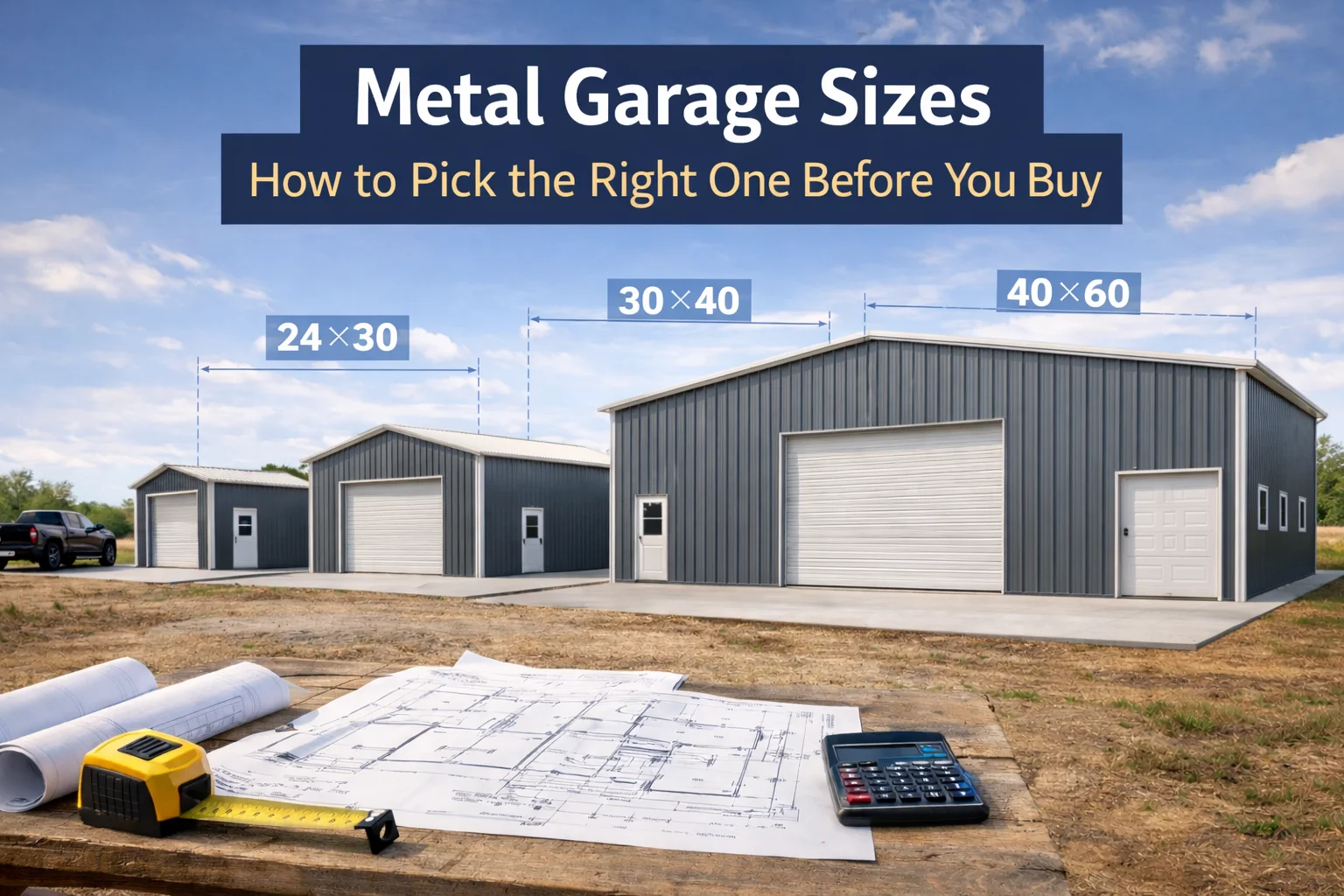
Common Metal Garage Sizes and 2026 Prices
All prices include free delivery + installation. Slab not included ($8–$10/sqft extra). Custom dimensions available — most dealers can build any size you need.
Let’s be honest about how most people pick a garage size. They think about how many cars they own, round up to the nearest “sounds right” number, and call it a day. Two cars, so a 2-car garage. Done.
And then, six months after install, one car’s parked in the driveway because the riding mower, the chest freezer, the toolbox, and “just a few boxes” have quietly eaten half the floor space.
Size is genuinely the hardest thing to fix after the fact. You can add a door. You can change the roof color. You can run electrical later. But if you need six more feet of width after the anchors are in the ground, that’s not a modification — that’s a rebuild. So it’s worth thinking about properly before you sign anything.
This guide is written to help you get there. Not just a table of dimensions and prices, but the actual logic behind which size fits which situation — including the vehicle clearance numbers, the leg height stuff most guides skip entirely, and the real cost math on going one size up.
People plan for right now. Not for three years from now.
The couple with two cars orders a 24×24. Makes perfect sense — it’s called a 2-car garage, they have 2 cars. What they didn’t account for: the ATV that shows up the following spring, the second lawnmower when they upgrade, the random accumulation of stuff that every garage attracts like a magnet. Suddenly the 24×24 is doing its best but it’s not really a 2-car garage anymore. It’s a 1-car garage with ambitions.
Here’s the thing about going one size bigger — it usually costs a lot less than people expect. The jump from a 24×24 to a 24×30 is 144 square feet. That extra depth typically adds around $1,500 to $2,500 to the total. That’s less than a decent riding lawnmower. The cost per extra square foot actually shrinks as the building gets bigger, which means the hesitation about sizing up is often based on a mental estimate that doesn’t match reality.
The question that tends to reframe this decision: what will you wish you’d done in five years? Not what do you need today. Those two answers are almost never the same, and the one that matters is the second one.
A practical exercise before you order: sketch your vehicles and equipment on paper with real measurements. Everything you plan to store or park. Then add 20% for what you haven’t thought of yet. That number is a better starting point than counting cars.
“It’s a truck” is not a measurement. A Ford Maverick compact pickup is 199 inches long. A Ram 3500 crew cab long-bed dually is 248 inches. Same category, 49 inches of difference — and those two vehicles do not fit the same garage comfortably.
Before anything else, look up the actual dimensions of every vehicle you’re planning to park. Then add clearance for how you actually use a garage — not just getting the vehicle in, but being able to walk around it, open the doors fully, and reach the workbench at the back without turning sideways. That clearance math, not the vehicle length alone, is what determines whether a building actually works for you day-to-day.
| Vehicle Type | Typical Length | Typical Width | Min. Garage Width Recommended |
|---|---|---|---|
| Standard sedan / compact SUV | 175–185″ (14.5–15.5 ft) | 70–74″ | 12 ft |
| Midsize SUV (Explorer, 4Runner) | 188–196″ (15.5–16.3 ft) | 74–78″ | 14 ft |
| Full-size pickup (F-150, Ram 1500) | 209–232″ (17.4–19.3 ft) | 79–82″ | 14–16 ft |
| Extended cab / long bed pickup | 232–248″ (19.3–20.6 ft) | 80–84″ | 16–18 ft |
| Full-size van (Transit, Sprinter) | 220–264″ (18.3–22 ft) | 83–95″ | 16–18 ft |
| Crew cab dually (F-350, Ram 3500) | 245–252″ (20.4–21 ft) | 96–102″ | 18–20 ft |
| Class A RV / large motorhome | 264–432″ (22–36 ft) | 96–102″ | 20–22 ft minimum |
| Boat on trailer (20 ft boat) | ~288″ (24 ft + hitch) | 90–102″ | 20 ft |
A few numbers worth memorizing: add at least 3 feet on each side of the vehicle for door swings and walking clearance. Add 5–6 feet at the back wall if you want any useful storage space back there. If you’re planning to actually work in the garage — not just park — budget 8 feet of clear depth behind the parked vehicle for a workbench you can actually stand at.
A 12×20 is 240 square feet. It fits one car with enough room to open the doors and not much else. It’s the entry price — $6,999 delivered and installed — and for what it does, it does it reliably. If you’ve got one compact car, you live somewhere dry, and you’re primarily keeping rain off the hood, this works.
The honest truth about the 12×20, though, is that most buyers who order it end up wishing they’d gone to at least an 18×20. Not because they need to park differently, but because the 12×20 gives you zero margin for storage. There’s no room for a workbench, no corner for the lawnmower, nowhere to hang tools. It’s a parking spot with walls.
The 18×20 and 20×20 are where single-car garages actually become useful. An 18×20 gives you workbench space alongside the car. A 20×20 gives you all of that plus room for a motorcycle or a chest freezer or the random accumulation of whatever you’ll bring in eventually. Going from a 12×20 to a 20×20 typically adds $1,400 to $2,000 — genuinely small money for a building that you’ll be using for 20 years.
One vehicle that people consistently undersize for: full-size pickups with long beds. A Ram 1500 crew cab long-bed is 19.3 feet of vehicle. A 12×20 garage is 20 feet of interior depth. That’s 8 inches of clearance between the grille and the back wall, before the tailgate. Don’t do that. If you’re parking a long-bed truck, start at a 20×24 minimum.
| Size | Sq Ft | Fits What Comfortably | Starts At (Installed) |
|---|---|---|---|
| 12×20 | 240 sqft | 1 compact/midsize sedan — basic shelter only | $6,999 |
| 18×20 | 360 sqft | 1 vehicle + wall storage + small workbench | $7,845 |
| 20×20 | 400 sqft | 1 vehicle + mower + tool storage + chest freezer | ~$8,400 |
| 20×24 | 480 sqft | Long-bed pickup or tall SUV, single vehicle | Call for quote |
The 22×22 is technically a 2-car garage. Technically. If you’ve got two compact cars and you’re fine getting out of them carefully, it functions. But if either vehicle is a midsize SUV, a truck, or anything with a little bulk to it, you’ll be doing that awkward shimmy between the door mirror and the wall every single day. Most people get tired of that pretty fast.
The 24×24 is the real standard. Two feet more on each side makes an enormous practical difference — full door swings, comfortable walking clearance, no choreography required. At $9,786 installed it’s one of the most-ordered sizes and it’s one of the cleaner buying decisions: not the cheapest, but it does the job properly.
But here’s where I’d push back on the 24×24 for a lot of buyers: if you have a truck, or if you have any intention of using the back of the garage for anything beyond parking — a workbench, a tool chest, storage shelves — the 24×30 is almost always the smarter order. The extra 6 feet of depth transforms the building from a pure parking structure into something you can actually work in. The 24×30 starts at $11,817 installed. That’s a $2,031 jump for 144 square feet of genuinely usable space.
The 24×36 is for buyers who know they’ll be spending time in there. Two vehicles with real clearance, plus enough workshop depth to have tools laid out and a project running without reorganizing the whole building every time you need to access something. If that describes you, don’t talk yourself into the 24×30 to save money. You’ll regret it within a year.
| Size | Sq Ft | Real Talk on Who This Is For | Starts At (Installed) |
|---|---|---|---|
| 22×22 | 484 sqft | 2 compact cars only — tight squeeze with larger vehicles | ~$9,200 |
| 24×24 | 576 sqft | Standard 2-car — the right call for most buyers | $9,786 |
| 24×30 | 720 sqft | 2 vehicles + actual workshop or storage at back wall | $11,817 |
| 24×30 enclosed | 720 sqft | Fully enclosed version of above — better security | $12,549 |
| 24×36 | 864 sqft | Truck + SUV or 2-car + serious shop depth | Call for quote |
24 feet of width is the practical minimum for two-car garages where both cars are modern full-size vehicles. Going to 22 feet to save money almost always results in regret. The door-swing math doesn’t work — you’ll know within the first week.
Cross 30 feet of width and the building stops being a garage and starts being a facility. That’s not hyperbole — 30 feet of clear-span steel gives you fundamentally different layout options than anything narrower. Three full vehicles, or two vehicles with an actual shop taking up the third bay’s worth of floor. Either way, you’re not compromising on anything.
The 30×40 is the most popular size. Not the most popular size for any particular type of buyer — just the most popular. And there’s a good reason for it. 1,200 square feet at around $13 per installed square foot hits a sweet spot that nothing above or below quite matches. Enough room for three vehicles, or two trucks with serious workshop depth, or one of the more versatile storage-and-work setups you can build for the money. It starts at $15,401 installed.
The 30×50 is where serious hobbyists and people running a legitimate business out of their garage land. At 1,500 square feet and $24,300 installed, you can fit four vehicles comfortably, or run a 2-post lift in one bay while keeping two parking spots clear. The jump from 30×40 to 30×50 is significant in price — about $8,900 — but if you need the space, you need the space. Don’t buy a 30×40 and spend the next five years working around the thing you didn’t do.
| Size | Sq Ft | Best Fit | Starts At (Installed) |
|---|---|---|---|
| 30×30 | 900 sqft | 3 average vehicles or 2-car + full workshop bay | ~$14,200 |
| 30×40 | 1,200 sqft | Most popular: 3-car OR 2-car + serious shop | $15,401 |
| 30×50 | 1,500 sqft | 4-car or 3-car + lift bay, small business use | $24,300 |
| 30×60 | 1,800 sqft | 4-car with workshop, or light commercial | Call for quote |
What actually fits in a 30×40 — the specific version
What doesn’t fit: a Class A RV. Those need at least 40 feet of depth and 20+ feet of width. If that’s you, read the RV section below before you order anything.
RVs have a way of making people realize they’ve ordered the wrong building. The width of a Class A motorhome — 96 to 102 inches, which is 8 to 8.5 feet — already needs 14 feet of building width minimum just to clear the walls. Add any comfortable clearance and you’re looking at 16–20 feet as a real working minimum. That eliminates most standard garage sizes immediately.
The depth issue is even more significant. A Class C at 28 feet of vehicle length needs 32–34 feet of interior depth to close the door behind it. A 36-foot Class A needs 40 feet. A 40-foot fifth wheel needs 44 feet of depth. And the door opening itself has to be tall — most RVs need a 14-foot opening, which is nowhere near the standard 8 or 9-foot residential door. This is the dimension that catches people off guard most often.
An 18×30, which starts at $7,845, handles smaller Class B and Class C RVs. Anything over 28 feet of vehicle length really needs a 30×40 minimum, and if you want to be able to walk around the thing inside the building — which is genuinely useful for maintenance — you’re looking at 36×40 or wider as a practical footprint.
| RV / Boat Type | Vehicle Length | Min. Garage Needed | Door Height Needed |
|---|---|---|---|
| Class B (van conversion) | 18–22 ft | 16×24 minimum | 10–12 ft |
| Class C (mid-size) | 25–32 ft | 18×36 minimum | 12–14 ft |
| Class A (standard) | 33–40 ft | 20×45 minimum | 14 ft |
| Fifth wheel on pickup | 55–65 ft total | 20×65+ or split | 12–14 ft |
| Boat on trailer (under 22 ft) | 24–28 ft | 16×30 minimum | 10–12 ft |
| Boat on trailer (22–30 ft) | 30–38 ft | 20×42 minimum | 12–14 ft |
At 40 feet wide and beyond, this isn’t a residential garage anymore. These are working facilities — farm operations, contractor shops, equipment dealers, light manufacturing. A 50×60 commercial building at $52,045 delivers 3,000 square feet of clear-span steel with no interior columns eating up your floor plan. That’s more square footage than plenty of small-town auto shops, and it shows up as a finished structure ready to work in within a couple of days of the crew arriving.
Budget differently at this scale. The slab for a 50×60 at $8–$10 per square foot is $24,000–$30,000 on its own. Electrical infrastructure, permitting, and site prep all scale up accordingly. The building is roughly half the total project cost at this size — plan the rest before you order.
Width and length get all the attention. Leg height — the wall height of the building — gets almost none, right up until someone orders a 10-foot building for their 10.5-foot van.
Standard leg height is 8–10 feet. That’s fine for regular cars and most SUVs. But the moment you introduce a 2-post lift, a boat on a trailer with a T-top, a high-roof van, an RV, or basically any farm equipment with an enclosed cab — that standard height either doesn’t work or works so barely that it’s a problem every single time you use the building.
Adding leg height at the time of order costs $600–$1,400 on a 30×40. Adding it after the fact — if it’s even structurally feasible with the existing anchor system — costs several times that. This is a decision that costs very little to get right and a lot to fix if you don’t.
| Situation | Minimum Leg Height | Why It Matters |
|---|---|---|
| Standard car / SUV parking | 8 ft | Comfortable for standard vehicle rooflines |
| Full-size pickup, large SUV | 9–10 ft | Clearance for roof racks, antennas, accessories |
| High-roof van (Transit, Sprinter) | 10–12 ft | High-roof vans hit 9.5–10 ft with accessories |
| 2-post car lift (standard) | 11–12 ft | Lift raises vehicle 72″+ off floor |
| 4-post drive-on lift | 10–11 ft | Lower profile but vehicle + lift = significant height |
| Boat on trailer (any size) | 12–14 ft | Mast, T-tops, and trailer profile vary widely |
| Class A RV / large motorhome | 14–16 ft | Motorhome rooflines routinely reach 12–13 ft |
| Farm equipment (tractor with cab) | 14–16 ft | Enclosed cabs alone hit 10–12 ft easily |
Rule of thumb worth remembering: if anything going into the building is taller than a standard SUV, order 12-foot legs minimum. Don’t assume standard height will be “probably fine.” Look up the actual height of the specific piece of equipment, add 18 inches of clearance, and order accordingly.
This is where a lot of size decisions get made or unmade. People have a number in their head, they see the next size up, assume it’s a big jump, and stick with smaller. Sometimes that’s the right call. But often the math is gentler than the assumption.
Here’s what the actual cost difference looks like between common adjacent sizes — all figures based on installed pricing for standard vertical roof configurations:
| Size Step | Extra Sq Ft | Approx. Added Cost | Cost Per Extra Sq Ft |
|---|---|---|---|
| 12×20 to 18×20 | +120 sqft | ~$846 | ~$7.05/sqft |
| 18×20 to 20×20 | +120 sqft | ~$555 (approx.) | ~$4.60/sqft |
| 24×24 to 24×30 | +144 sqft | ~$2,031 | ~$14.10/sqft |
| 24×30 to 24×36 | +144 sqft | ~$1,500–$2,000 | ~$10–$14/sqft |
| 30×30 to 30×40 | +300 sqft | ~$1,200–$2,000 | ~$4–$7/sqft |
| 30×40 to 30×50 | +300 sqft | ~$8,899 | ~$29.66/sqft |
A few things worth noting in that table. The 30×30 to 30×40 jump is unusually cheap per square foot — that’s a quirk of how the structural framing scales for those particular dimensions, and it’s one reason the 30×40 is such a dominant seller. On the other hand, the 30×40 to 30×50 jump is expensive per square foot relative to the others, which is why buyers at that level often jump straight to 30×60 when the budget allows.
The general principle: the cost difference between “right size” and “size I’ll compromise with” is almost always smaller than people’s mental estimate. Do the actual math before you decide.
Roof style affects price, and price affects size decisions, so it’s worth understanding how they interact before you finalize a size.
Three options exist: regular roof (horizontal panels, rounded ridge, entry-level price), A-frame horizontal (same horizontal panels, pitched like a house, better curb appeal, similar weather limitations), and vertical roof (panels run top-to-bottom, everything sheds off, significantly better long-term performance in any climate that sees real weather).
On a small building in a mild climate, the roof style decision is genuinely low-stakes. On a 30×40 in Ohio or Pennsylvania that’s going to see heavy snow for 20 years — the choice matters a lot more. Larger buildings have more surface area for water and snow to sit on, so the horizontal seam vulnerability of regular and A-frame roofs becomes more significant as the building footprint grows.
Practical implication for sizing: if you’re deciding between two sizes and the vertical roof premium is pushing you toward smaller, it’s worth knowing what that premium actually is. On a 30×40, going from regular to vertical roof adds roughly $4,600–$6,000. In a climate with real winters, that premium buys meaningful long-term performance over a 20-year lifespan. Don’t sacrifice size to cover a roof upgrade if sizing down creates a building you’ll be frustrated with day-to-day.
Full roof style comparison: Metal Garage Roof Styles
The building has to fit the lot, not just the vehicles. A few things worth checking before you commit to a footprint:
Everything in one table, with real 2026 prices:
| Size | Sq Ft | Cars (typical) | Primary Use | Starts At |
|---|---|---|---|---|
| 12×20 | 240 | 1 compact | Basic single-car shelter | $6,999 |
| 18×20 | 360 | 1 standard | 1 car + tool storage + small bench | $7,845 |
| 18×30 | 540 | 1 + extras | Compact RV or 1-car with serious storage | From $7,845+ |
| 20×20 | 400 | 1–2 compact | 1 car + mower + chest freezer | ~$8,400 |
| 22×22 | 484 | 2 compact | Tight 2-car, compact vehicles only | ~$9,200 |
| 24×24 | 576 | 2 standard | Standard 2-car, the most common size | $9,786 |
| 24×30 | 720 | 2 + storage | 2-car + workbench or storage at back | $11,817 |
| 24×30 enclosed | 720 | 2 + storage | Enclosed 2-car + storage | $12,549 |
| 24×36 | 864 | 2–3 | Truck + SUV or 2-car + full shop | Call |
| 30×30 | 900 | 3 | 3-car or 2-car + workshop bay | ~$14,200 |
| 30×40 | 1,200 | 3+ | Most popular — 3-car or 2-car + real shop | $15,401 |
| 30×50 | 1,500 | 4 or 3 + lift | Auto hobbyist / small commercial use | $24,300 |
| 40×60 | 2,400 | 5–6 | Farm, contractor, commercial | Call |
| 50×60 | 3,000 | 6–8 / commercial | Full commercial — 3,000 sq ft clear-span | $52,045 |
All installed prices include free delivery and professional installation in the continental US. Concrete slab, permit fees, and site prep are separate costs. Prices reflect 2026 pricing and vary by state based on engineering requirements. For a specific quote with your zip code factored in, call (866) 503-4010 or use the 3D Builder.
The honest answer: a 24×24 is the minimum that works comfortably for two standard vehicles, and it’s where most buyers land — starting at $9,786 installed. If either car is a full-size truck or larger SUV, or if you have any storage ambition for the back wall, go to 24×30 ($11,817 installed) instead. The extra 6 feet of depth changes the building from a parking spot to something actually usable. The 22×22 is technically a 2-car option but it’s a squeeze with any modern full-size vehicles — most people who order it wish they’d gone wider.
The 30×40 — by a significant margin. 1,200 square feet, starting at $15,401 installed. It hits the right balance of size, cost efficiency, and actual usability: three vehicles with room to move, or two trucks plus a workshop setup that doesn’t require reorganizing every time you need to access something. At around $13 per installed square foot, it’s also where the cost math starts really working in steel’s favor.
Depends on the class. Class B van conversions can fit in an 18×24 minimum. Standard Class C RVs need 18×36 at minimum. Class A motorhomes need 20×45 or larger — and 14-foot door openings, not the standard 8–9 foot residential door. That door height requirement is what most people forget, and it eliminates a lot of standard-size quotes. If you’re parking anything over 28 feet, start with a 30×40 as your baseline and adjust from there.
Standard 8–10 foot leg heights work fine for regular cars and most SUVs. Go to 12 feet minimum if you’re installing any kind of lift, parking a high-roof van, or storing a boat with a T-top. Go 14–16 feet for Class A RVs or large farm equipment with enclosed cabs. The critical thing to know: adding height at order time costs $600–$1,400 on a 30×40. Adding it after installation is a structural job that costs several times more — in most cases it isn’t even practical. Decide before you sign.
There’s no universal answer — it varies by county and state. Some rural counties have no permit requirement for structures under a specific square footage (often 200–400 sqft). Most suburban and urban counties require permits for any permanent structure. Some Florida and California counties require stamped engineering drawings even for small metal buildings. The only reliable way to know is to call your county building department and ask directly. Don’t assume based on what someone else built in the same area — requirements change and vary by parcel type.
The building starts at $15,401 delivered and installed — that includes the steel structure, delivery, and professional installation but not the foundation. A concrete slab for a 30×40 runs $9,600–$12,000 at the $8–$10 per square foot rate. If you’re adding insulation, a roll-up door, and a walk-in door to a building in a state with engineering requirements, a fully functional 30×40 workshop realistically lands between $28,000 and $35,000 total depending on your location and configuration.
Size is the one decision in a metal garage project where being wrong is expensive to fix. Everything else — door placement, color, even roof style — can be adjusted or swapped. Square footage cannot. The slab is in the ground. The anchors are set. The footprint is permanent.
Most of the people who end up frustrated with their garage size made the same mistake: they sized for the situation they had, not the situation they’d have. The buyer who thought carefully about the situation three years out — including the equipment they’d accumulate, the projects they’d take on, the things they hadn’t bought yet — almost always ended up with a building they were happy with.
Steel is forgiving on cost in a way that wood construction isn’t. The upgrade from “probably fine” to “exactly right” is usually a few thousand dollars on a structure you’ll use every day for two decades.
It is fast and easy. Get your instant quote today!