March 13, 2026

Buildings up to 100' wide and 24' high now available.
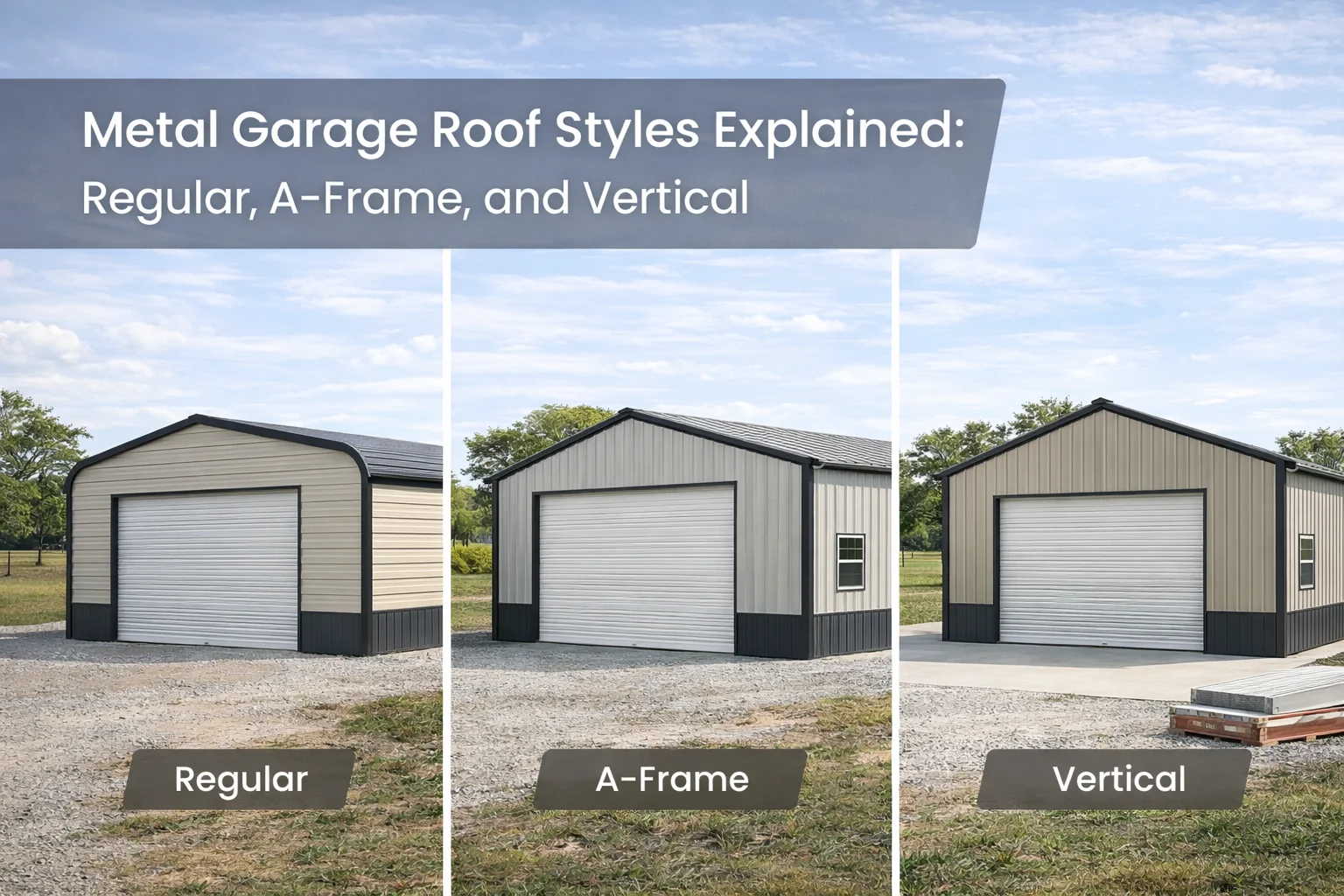
The 3 Metal Garage Roof Styles
Regular Roof — Horizontal panels, rounded corners. Lowest price.
Best for: Mild, dry climates. Basic storage. No sustained wind or snow.
A-Frame Horizontal — Peaked like a house, horizontal panels. Mid-range.
Best for: Moderate climates. Residential neighborhoods. Better looks.
Vertical Roof — Panels run top-to-bottom. Highest price. Best performance.
Best for: All climates. Required in many wind and snow zones.
The price difference between a regular roof and a vertical roof on a 30×40 garage is roughly $1,600–$3,000. In most climates, it’s worth it.
All three styles are available on metal garages starting at $6,999 installed.
Of all the decisions in a metal garage order, roof style is the one most people make based on price alone. They see three options, notice the cheapest one is a few hundred dollars less, and pick that. Then they live in Ohio or North Carolina and wonder why they’re dealing with rust along the panel seams after three winters.
The roof style decision is genuinely consequential — maybe not in Arizona, but in most of the country, yes. It affects how water and snow behave on the building, how long the panels last before showing wear, and in some states, whether the building meets local engineering requirements at all. It’s worth understanding what you’re actually choosing between.
This isn’t a complicated topic once you understand the mechanics. There are three styles. Each one has a specific structural difference. That difference determines how weather interacts with the roof surface. Everything else — cost, longevity, which climate it suits — follows directly from that one structural fact.
Panel direction. That’s it.
On a regular roof and an A-frame horizontal roof, the metal panels run horizontally — from the front of the building to the back. They lay across the roof parallel to the ground. On a vertical roof, the panels run perpendicular to the ground — from the peak down to the eave, top to bottom.
That single difference — which way the corrugation runs — is what drives everything else. Horizontal panels mean water flows across the seams between panels before it reaches the edge of the roof. Vertical panels mean water hits a panel face and runs straight down to the ground without crossing a seam. Snow behaves the same way. Debris, leaves, dirt — all of it.
The seam is where moisture accumulates. Moisture accumulation is where rust starts. Rust is where roof problems begin. So the question of which roof style you need is really a question of how much seam exposure your climate creates — and whether that matters for your specific situation.
Simple way to think about it: imagine pouring water slowly across the roof. On a horizontal panel roof, water crosses several seams before falling off the edge. On a vertical panel roof, it runs straight down the face of one panel. That’s the entire engineering argument for vertical.
The regular roof is the base option. Horizontal panels running front to back, with rounded corners at the eaves instead of a sharp peak. No ridge cap running down the center — the panels just meet at the top with a rounded profile.
It’s the simplest construction of the three and, not coincidentally, the cheapest. Installation is straightforward, material cost is lower, and the rounded corner design actually has one specific structural advantage — no seam at the peak means no peak seam to leak if the building ages or if someone in a wet climate installs this when they shouldn’t have.
Where a regular roof genuinely makes sense: dry climates with low annual precipitation, mild temperatures year-round, and no sustained high winds. If you’re in central California, parts of Nevada or Arizona, or similar areas where the main weather event is heat — a regular roof is perfectly appropriate for basic vehicle or equipment storage. It does what it’s supposed to do. Nobody needs to talk you into an upgrade you don’t need.
Where it doesn’t belong: anywhere that gets real winter. The horizontal seams on a regular roof collect debris and hold moisture. In a climate that freezes and thaws repeatedly, that trapped moisture accelerates corrosion at the seam lines. It’s not catastrophic — it’s gradual. But after ten years in a northern climate, a regular roof building is going to show its age noticeably faster than a vertical roof building next to it.
The A-frame horizontal roof — also called boxed-eave on some product pages — adds a peaked center to the regular roof design. Instead of the rounded profile, the roof comes to a point in the middle, like the roofline on a conventional house. The panels still run horizontally, same as the regular roof. Only the shape of the ridge changes.
That peak does one thing well: it sheds water faster toward the sides than a flat-top rounded roof does. Rain hits the center ridge and runs diagonally toward the eaves rather than pooling in the middle. For moderate rain climates, this is a meaningful improvement over the regular roof. It’s also the style that looks most like a residential structure — which matters if the building is in a neighborhood or visible from the street.
The honest limitation: the panels are still horizontal. All the seam-related issues that affect a regular roof in wet or cold climates apply equally here. The better pitch helps with rain runoff. It does nothing different for snow accumulation or seam moisture in freeze-thaw cycles. Buyers who choose the A-frame over the regular roof for weather performance reasons in a cold climate are solving the wrong problem.
Choose the A-frame horizontal if aesthetics are a priority and your climate doesn’t push into genuine winter conditions. Choose it if you’re in a neighborhood where a rounded-corner industrial profile would stand out awkwardly. Choose it if you want the residential look and you live somewhere the weather cooperates. Don’t choose it as a meaningful weather upgrade over a regular roof if you’re in a four-season climate — that’s not what it is.
The vertical roof has the same peaked A-frame shape as the horizontal option. What’s different is the panels — they run from the top of the roof straight down to the eave, perpendicular to the ground. The corrugation channels run vertically.
During manufacturing, additional framing components are installed that don’t exist on the other two styles: hat channels running horizontally across the structure to support the vertical panels, and a ridge cap running the full length of the peak. These additions increase the material cost and require more precision during installation. They also produce a roof that handles weather in a fundamentally different way.
Water hits a vertical panel and runs straight down to the ground. It doesn’t travel across seams. Snow slides off the face of the panel rather than sitting in horizontal channels. Leaves, debris, and dirt — same thing. The roof stays cleaner passively, and the seams experience less sustained moisture contact, which is where corrosion originates on the other two styles.
In practical terms: a vertical roof building in Ohio looks noticeably better after ten years than a regular roof building in the same climate. The difference widens with time. The warranty is the same — 20-year rust-through — but the vertical roof is considerably more likely to reach that milestone without visible surface wear.
It’s also worth knowing that vertical roof is the required style — not recommended, required — in Florida hurricane zones and most coastal wind certification areas. Structures longer than 36 feet typically require vertical roof regardless of climate, because the structural framing for longer spans demands it. If your building hits that length or your county’s engineering requirements include wind certification, the roof style choice is already made for you.
| Feature | Regular Roof | A-Frame Horizontal | Vertical Roof |
|---|---|---|---|
| Panel direction | Horizontal | Horizontal | Vertical |
| Ridge profile | Rounded, no peak | Peaked (A-frame) | Peaked (A-frame) |
| Extra framing | None | None | Hat channels + ridge cap |
| Water shedding | Moderate | Better than regular | Best — direct runoff |
| Snow performance | Weak in heavy snow | Weak in heavy snow | Strong — slides off face |
| Debris accumulation | Moderate | Moderate | Minimal |
| Corrosion risk (cold) | Higher over time | Higher over time | Lower — less seam moisture |
| Curb appeal | Industrial/utilitarian | Residential-style look | Clean, modern, premium |
| Wind certification | Available | Available | Required in many wind zones |
| Price (vs regular base) | Base price | +$800–$1,800 | +$1,600–$3,000+ |
| Best climate | Mild and dry | Moderate | All climates |
The price gap between roof styles is smaller than most buyers expect when they first see three options on a quote. Here’s what the upgrade actually costs on common building sizes, based on current 2026 pricing:
| Building Size | Regular Roof | A-Frame Horizontal | Vertical Roof | Regular → Vertical Gap |
|---|---|---|---|---|
| 12×20 | $6,999 | ~$7,800 | ~$8,600 | ~$1,600 |
| 24×24 | $9,786 | ~$10,900 | ~$11,700 | ~$1,900 |
| 24×30 | $11,817 | ~$13,200 | ~$15,000 | ~$3,200 |
| 30×40 | $15,401 | ~$17,200 | ~$18,900 | ~$3,500 |
| 30×50 | $24,300 | ~$26,400 | ~$28,800 | ~$4,500 |
A few things worth noting. The gap between regular and vertical on a 12×20 is about $1,600. That building is going to be used for 20+ years. That’s $80 a year for a meaningfully better-performing roof in any climate that sees real weather. On a 30×40 the gap is around $3,500 — on a $15,000+ structure with a 20-year lifespan, that’s $175 a year.
The buyers who regret the upgrade decision almost always went with the cheaper option to save that delta. The ones who don’t think about it much after the fact are the ones who paid for vertical and just… never had to think about their roof.
One more cost consideration worth knowing: if you live in a state where vertical roof becomes required after the fact — say, you apply for a permit and the county inspector requires wind certification — retrofitting a vertical roof onto an existing regular or A-frame structure is significantly more expensive than ordering it correctly from the start. This happens. It’s avoidable.
This is the question most buyers don’t ask until after they’ve ordered. In some states and counties, vertical roof isn’t a preference — it’s the only option that passes inspection.
| State / Region | Roof Style Situation |
|---|---|
| Florida (all zones) | Vertical roof typically required for wind certification. Miami-Dade has strictest standards. |
| Coastal Texas | Wind zone requirements in many counties effectively require vertical roof for certification. |
| Gulf Coast (AL, MS, LA) | High-wind zones along the coast require certified structures — vertical roof standard. |
| Carolinas (coastal areas) | Wind zone II/III counties require certified buildings — vertical roof is the norm. |
| Northeast (PA, NY, MA, ME) | Snow load requirements don’t mandate vertical, but it’s strongly recommended given freeze-thaw cycles. |
| Mountain West (CO, WY, MT) | Heavy snow load areas — vertical performs significantly better, certification sometimes requires it. |
| Midwest (OH, IN, IL, MO) | No mandate in most counties, but four-season weather makes vertical the practical choice. |
| Central / Plains states | Standard codes in most areas — all three styles available, vertical recommended for longevity. |
| Any building over 36’ long | Vertical roof is typically required regardless of state due to structural framing requirements. |
The honest advice: before finalizing your roof style, tell your dealer your zip code and ask directly whether your county requires certification and whether that affects the roof style. A five-minute conversation up front prevents a much longer one after delivery.
If you’re still unsure after reading through all three, this framework covers the vast majority of buying situations:
States where regular roof is genuinely appropriate: Arizona, Southern California, interior Nevada, New Mexico, parts of central Texas and inland Florida.
Best fit: Suburban Southeast, moderate Midwest, areas with mild winters where the building needs to blend with residential surroundings.
Honest take: for most buyers in most of the country, vertical is the right call. The exceptions are dry-climate storage applications where budget is the constraint.
Roof style is the biggest variable in how a metal roof performs, but it’s not the only one. The gauge of the steel matters too — and it’s a spec worth asking about when you’re comparing quotes.
Standard metal garage framing is available in 12-gauge and 14-gauge galvanized steel. The lower the gauge number, the thicker the steel. 12-gauge is heavier and stronger — better for larger buildings, high-wind areas, or heavy snow load requirements. 14-gauge works well for smaller structures in standard conditions.
Both are galvanized — meaning the steel is coated in a layer of zinc that slows corrosion. The galvanized coating is what makes the 20-year rust-through warranty realistic. But the coating isn’t permanent, and prolonged moisture exposure at panel seams degrades it faster. Which brings it back to roof style — the less water sits on the roof, the longer the galvanization does its job.
When comparing quotes: confirm both the frame gauge (12 or 14) and the roof panel gauge. Some dealers use heavier framing but lighter panels, or vice versa. For a building you intend to use for 20+ years, 12-gauge framing on larger structures is worth asking about specifically.
The core difference is panel direction. A regular roof has horizontal panels running front to back, with rounded corners at the eaves. A vertical roof has panels running from the peak down to the eave, top to bottom, with a peaked center and additional framing including hat channels and a ridge cap. That panel direction determines how water and snow move off the roof. Vertical panels shed weather directly off the panel face without crossing seams. Horizontal panels move water across seams before it reaches the edge, which causes faster wear at the seam lines in wet or cold climates.
Vertical roof is significantly better for snow than the regular or A-frame horizontal styles. Snow lands on a vertical panel face and slides down to the ground, the same way water does. On horizontal panel roofs, snow sits in the corrugation channels between panels, adding weight to the structure and holding moisture against the seams as it melts and refreezes. In heavy snow states like Ohio, Pennsylvania, New York, or Colorado, vertical roof is the practical choice. In many of those counties, it’s also required for snow load certification.
For most buyers in most climates, yes. The price difference between a regular roof and a vertical roof on a 30×40 building is roughly $3,500. That building will be used for 20+ years. The annual cost of the upgrade is around $175 — less than a single service visit for most equipment. What you’re buying is a roof that handles weather without accumulating moisture at seams, which is the primary cause of early wear on metal buildings. In mild, dry climates with no sustained weather, the upgrade is genuinely optional. In four-season climates, it earns its cost back in avoided maintenance.
An A-frame horizontal roof — also called boxed-eave — is a metal garage roof style with a peaked center ridge, like a conventional house roofline, and horizontal panels running the length of the building. The peaked profile sheds rain faster than a rounded regular roof, and it has a more residential appearance that blends better in neighborhoods. The panels are still horizontal, so it shares the same seam vulnerability as a regular roof in heavy snow or freeze-thaw climates. It’s a good choice for moderate climates where aesthetics matter.
In most of Florida, yes — especially in wind zones, which cover the majority of the state. Wind certification requirements for metal structures in Florida typically require a vertical roof with proper framing and anchor specifications to meet the required wind ratings. In Miami-Dade County specifically, the standards are stricter than anywhere else in the state. If you’re ordering a metal garage in Florida and a dealer quotes you without mentioning wind certification, ask specifically — a building that can’t be permitted isn’t usable.
Vertical roof is typically required for metal buildings longer than 36 feet, regardless of state. This is a structural requirement, not just a performance recommendation. Buildings over 36 feet in length require the additional framing — hat channels and ridge cap — that comes standard with vertical roof construction to support the extended span properly. If you’re ordering a 40×60 or 30×50 building, the roof style decision is already made by the building’s own length.
The roof style decision sounds technical but it really comes down to one question: how much weather does this building need to handle, and for how long?
If the answer is “not much” — dry climate, mild temperatures, basic storage — a regular roof is fine and the upgrade is genuinely optional. If the answer is “real winters” or “coastal weather” or “this is a workspace I’ll use daily for the next 20 years” — vertical roof is the only one of the three that was engineered for that job.
The A-frame horizontal sits in the middle and does the middle thing well: it looks better than a regular roof, sheds rain a bit faster, and costs less than vertical. In the right climate and the right setting, it’s the sensible choice. In a snowbelt or wind zone, it’s the wrong one.
Most of the country gets real weather. Most buyers who think carefully about the decision end up at vertical roof. The ones who get there after already ordering the other two pay more in the end. The panel direction is a small detail that turns into a large one over the life of the building.
It is fast and easy. Get your instant quote today!