March 13, 2026

Buildings up to 100' wide and 24' high now available.
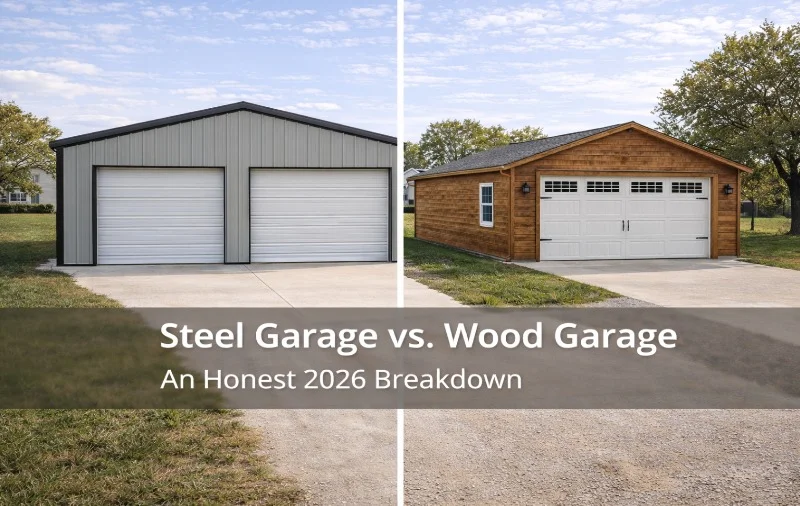
Steel garages start at $6,999 delivered and installed. A comparable site-built wood garage will run $18,000–$28,000 before you factor in the ongoing maintenance — repainting every few years, pest control in termite country, and a new roof around year 12. Over 15 years, most homeowners spend $20,000–$50,000 more on a wood garage than a steel one.
Wood wins if you have HOA restrictions, a high-value historic property, or want a finished bonus room above the garage. For everyone else, the math in 2026 points clearly to steel — and it’s not that close.
Five years ago, this comparison was closer than it is today. Wood was expensive, sure, but labor was manageable and lumber prices, while elevated post-pandemic, were starting to level out. That’s not the situation anymore.
Framing lumber is running at roughly $850–$900 per thousand board feet heading into 2026 — up nearly 17% year-over-year. The US tariffs on Canadian softwood lumber, currently between 14% and 21% are adding real cost to every stick-built project in the country. Contractors in the Southeast and Midwest are quoting wood garage builds at prices that would have seemed absurd in 2019.
Steel, by comparison, has held relatively flat. Domestic production has kept prices stable for standard gauge building steel, and the prefab model — where a factory builds your garage components and ships them directly — eliminates a large chunk of the labor cost that’s been eating wood garage budgets.
If you pulled an estimate from a website in 2021 or 2022, it’s wrong. The gap between steel and wood has widened considerably. Run current numbers before you decide — starting with the table below.
Most articles on this topic compare the upfront purchase price and stop there. That’s the wrong way to look at it. A garage is a big and long term investment. The total cost of ownership includes purchase price, maintenance, and what you lose in time — is the number that actually matters.
| Garage Size / Use | Prefab Steel — Delivered + Installed | Site-Built Wood — Materials + Labor (2026) |
|---|---|---|
| 12×20 — single car | From $6,999* | $12,000 – $18,000 |
| 20×20 to 24×24 — 2-car | $3,500 – $10,000* | $18,000 – $28,000 |
| 30×40 — large enclosed / workshop | ~$16,000* | $45,000 – $65,000+ |
| 40×60+ — commercial / multi-use | $25,000 – $45,000+* | $80,000 – $120,000+ |
* Accessories and local wind/snow load requirements may affect final cost. Concrete slab not included.
This is where the comparison becomes decisive. Wood’s disadvantage isn’t just the upfront price — it’s every dollar you spend keeping it standing over the next decade and a half.
| Cost Category | Prefab Steel Garage | Site-Built Wood Garage |
|---|---|---|
| Purchase + installation | $8,000 – $14,000 | $28,000 – $42,000 |
| Exterior repainting (every 3–5 yrs) | $0 — factory finish | $1,500 – $4,500 over 15 yrs |
| Roof maintenance / replacement | $200 – $400 (bolts + touch-up) | $3,500 – $8,000 (yr 12–15) |
| Pest control — termite regions | $0 | $2,000 – $6,000+ over 15 yrs |
| Rot / warp / structural repairs | $0 | $800 – $4,000 (climate-dependent) |
| Insurance savings — steel discount | $750 – $2,250 saved over 15 yrs | $0 discount |
| Estimated 15-Year Total Cost | $8,500 – $16,000 | $35,000 – $66,000+ |
The gap — anywhere from $20,000 to $50,000 over 15 years on a mid-size garage — is why the math on this decision has shifted so far toward steel. The upfront premium of a wood build doesn’t pay itself back in aesthetics, resale value, or performance. It just costs more money.
Lifespan numbers without context are marketing. A steel garage in Louisiana faces completely different conditions than one in high-desert Colorado. Here’s what you’re actually up against in each major US climate zone — and what it means for your material choice.
Snow load is the headline concern here, and steel handles it well when it’s specified correctly. A vertical roof steel garage — where the panels run perpendicular to the ridge — sheds snow rather than holding it. That distinction between regular roof and vertical roof matters enormously in heavy snow country. If a supplier is quoting you a regular-roof building for a region that routinely sees 24+ inch snow events, push back and ask about vertical roof certification.
Wood garages handle snow loads too, but cheaper builds often underspec the truss system for the span width. The problems don’t show up in year one. They show up in year six after two back-to-back heavy winters, when you start seeing ridge deflection. Proper structural engineering for a wood garage in snow country isn’t cheap — and it’s a cost that often gets cut during the quote process.
Freeze-thaw cycles are the other factor. Wood joints that take moisture in November and freeze in December start working loose over years. Metal doesn’t have that problem.
This is where I’ll be most direct: if you’re in a Formosan termite zone — which covers the entire Gulf Coast and most of the Southeast — a wood garage is a long-term liability. Formosan termites in Louisiana and coastal Florida aren’t the standard subterranean species most of the country deals with. They can compromise load-bearing framing in three to five years without visible surface symptoms. By the time you notice something’s wrong, you’re looking at structural repairs, not cosmetic ones.
Steel wins in the Southeast. That’s not debatable. Add the humidity load on wood siding, the mold pressure in that climate, and the shortened paint cycle, and there’s no real case for wood unless aesthetics are the absolute priority and budget is genuinely open-ended.
This is the one region where steel deserves a fair critique. Salt air is hard on steel — specifically at cut edges, screw holes, and anywhere the galvanized coating has been scratched or compromised. A steel garage installed 500 feet from the ocean that never gets inspected will start showing corrosion at those points within five to ten years.
The solution is straightforward: use a supplier who specifies coastal-grade galvanization, do an annual walk-around to catch and touch up any surface rust before it spreads, and make sure the base channel drains properly and doesn’t pool water. That’s 20 minutes once a year. A well-maintained cedar-sided wood garage on the coast can sometimes compete on durability with a neglected steel garage — but “neglected” is doing a lot of work in that sentence.
Wood performs better in dry climates than anywhere else in the country. Rot pressure is low, and the main enemy for both materials is UV degradation — which both require UV-resistant coatings to address equally. Arizona does carry subterranean termite risk, so that’s not zero, but it’s more manageable than Gulf Coast exposure.
Steel still wins on upfront cost and installation speed in the Southwest. But if you’re in a dry climate and have a wood quote that’s genuinely competitive — which is less common now with lumber tariffs — the durability penalty for choosing wood is smaller here than anywhere else in the country.
Walk through this-
Year one, both garages look fine. The wood garage has fresh paint, the steel garage has its factory finish. You don’t spend a dollar on maintenance for either one.
Year three. The steel garage looks the same. The wood garage — in any climate with real humidity or sun exposure — has started to show minor checking in the paint on the south-facing wall. Not a disaster. Maybe you touch it up yourself on a Saturday. Twenty dollars and a few hours.
Year five. You’re looking at repainting the wood garage. In the Southeast, you might be there by year four. A full exterior repaint on a 24×30 wood structure, done by a contractor, runs $1,200–$2,500 depending on your market. If you do it yourself, budget a weekend of prep plus application time. The steel garage at year five: nothing. Maybe tighten one anchor bolt that’s backed out slightly during an inspection that takes ten minutes.
Year eight. The wood garage in termite country needs treatment if you haven’t been on top of annual pest control. If you have been — $200–$400 per year is a known, recurring cost. If you haven’t, year eight is when you start paying for that neglect. A pest control company does an inspection and finds framing damage in a wall bay. Small repairs run $800–$1,500. Bigger ones are worse. The steel garage at year eight: no pest control. Ever.
Year twelve. The wood garage roof is starting to look rough. Asphalt shingles on an unheated detached garage experience more extreme temperature cycling than the house roof — they tend to go faster than you’d expect. You’re looking at the beginning of the end for that roofing. Budget $4,000–$8,000 for a re-roof in the next few years. The steel garage roof at year twelve: still there, still doing its job. A properly installed vertical roof panel system can last 40 years.
Year fifteen. The wood garage owner has spent, conservatively, $8,000–$22,000 in maintenance on top of the original purchase price. The steel garage owner has spent somewhere under $600 — mostly one exterior touch-up on a scratched panel and annual ten-minute inspections.
That’s not a hypothetical scenario designed to make one material look bad. That’s the actual trajectory of both structures in a standard US climate.
The image most people have when someone says “metal garage” is a corrugated tin shed from 1978 with rust streaks and a roll-up door that won’t track right. That product hasn’t been the standard in the residential prefab market for a long time.
Modern enclosed steel garages — particularly fully enclosed buildings with vertical roof panels, residential color packages, painted trim, walk-in entry doors, and framed window openings — look nothing like that. There are configurations that, from 30 feet away on the street, read as a conventional detached garage. They’re not indistinguishable from custom wood construction, but they’re not an eyesore either.
That said, I want to be honest with you: if you have a craftsman bungalow, a Victorian, or a classic farmhouse with cedar siding and detailed trim, a custom wood garage built to match will look better than a steel garage. Full stop. The question isn’t which looks better in isolation — it’s whether that visual match is worth paying two to three times as much and then maintaining the structure for decades.
For most homeowners, the honest answer is no. For some — particularly those with high-value properties, strict HOA requirements, or a genuine commitment to a specific architectural vision — the answer is yes. Those people should build the wood garage.
One persistent myth is that metal garages are harder to permit than wood. The opposite is usually true.
Both structures require a permit in most US municipalities for any detached garage over 200 square feet — that’s not a steel-specific requirement. But steel has a practical advantage in the permit process: most reputable prefab suppliers include certified engineering drawings with wind and snow load calculations as part of the sale. The permit application is ready to file.
For a site-built wood garage, you’re often hiring a structural engineer separately to get those drawings stamped — $400–$1,200 out of pocket before a single board gets cut. That cost is already built into what a steel supplier charges you.
On installation timeline: a site-built wood garage takes 3–6 weeks from groundbreak to completion, longer in bad weather or if your contractor has a backlogged schedule. A prefab steel garage is fully installed in 1–3 days once your concrete slab is ready and the crew shows up. If you need a working garage by a specific date, steel is almost always the more reliable path.
On the concrete slab: both materials need one. Budget $3,000–$8,000 for a standard 24×30 concrete pad depending on local pricing, site access, and whether any grading is needed. That cost is separate from the building quote.
Almost every comparison article on this topic ignores insurance. That’s a mistake — it’s real money over a 15-year ownership period, and it consistently favors steel.
Steel buildings are classified as non-combustible structures by most US insurance carriers. Wood buildings are combustible. That’s not a technicality — it’s the actual fire science, and it translates directly into annual premiums. Depending on your carrier and your state, insuring a steel detached garage can cost 5–15% less per year than insuring a comparable wood structure.
On a structure insured for $15,000 in replacement value, that’s a modest saving — $50–$150 per year. Over 15 years, that’s $750–$2,250 back in your pocket. Not a life-changing number, but it belongs in any honest total-cost-of-ownership comparison.
The practical fire issue matters more. Garages have a high rate of total-loss fire claims — electrical faults, fuel storage, heat sources. A steel garage doesn’t contribute structural fuel to a fire the way wood does. An interior fire in a steel structure is much more likely to be contained than the same fire starting in a wood garage, where the framing itself becomes part of the burn.
Before you finalize your decision, call your homeowner’s insurance agent and ask directly what the annual premium difference would be between a steel and wood detached structure at your property. Get an actual number. It belongs in your budget.
Steel wins most of these categories, not going to pretend otherwise. But wood is genuinely the better choice in specific situations — and if you’re in one of those situations, you should build the wood garage.
For everyone who doesn’t fall into those categories — the practical majority of homeowners researching this question — steel is the correct answer in 2026.
Here’s how I’d walk through this with someone sitting across from me.
For the overwhelming majority of homeowners — budget-conscious, practical, not locked into HOA material restrictions, and wanting a structure that performs for decades without demanding constant attention — steel is the right answer. Not because it’s trendy, but because the cost math and the performance data both point the same direction.
Yes — significantly. A prefab steel garage starts at $6,999 delivered and installed for a single-car size. A comparable site-built wood garage runs $12,000–$28,000 at 2026 lumber prices for the same footprint. Over 15 years including maintenance, the total cost gap typically reaches $20,000–$50,000 in favor of steel.
A properly installed prefab steel garage lasts 20–40 years with minimal upkeep. Structures built with 12-gauge framing and vertical roof panels regularly reach 40+ years. Steel doesn’t rot, attract termites, or warp from moisture cycling — which are the primary failure modes that shorten wood garage lifespans in most US climates.
Modern prefab steel garages use galvanized steel coatings specifically engineered to prevent rust. Surface corrosion can develop at cut edges, screw holes, or paint scratches if left untreated — particularly in coastal salt-air environments within a few miles of the ocean. An annual inspection and touch-up of any compromised areas prevents this from becoming a structural issue. In non-coastal climates, rust is rarely a practical concern for buyers.
In most US municipalities, yes — any detached structure over 200 square feet requires a permit regardless of material. Steel has a practical advantage in this process: reputable prefab suppliers typically include certified engineering drawings with wind and snow load calculations as part of the purchase price. For wood garages, homeowners often hire a structural engineer separately for those same documents at $400–$1,200.
Modern residential-style steel garages with boxed eave rooflines, painted trim packages, walk-in doors, and window frames look significantly better than the corrugated sheds of 30 years ago. They won’t replicate the look of custom cedar siding or architectural wood detailing, but they read as conventional detached garages in most suburban contexts. HOA rules may still prohibit them where material matching is required.
In most US markets — suburban, rural, and working-class residential — a solid steel garage is a straightforward asset that adds functional square footage and appeals to practical buyers. A custom wood garage with high-end finishes may add slightly more perceived value in luxury or historic markets where visual match to the primary structure is meaningful. Neither material guarantees a dollar-for-dollar return on investment.
If you’ve done the math and you’re leaning toward steel, here’s what to have ready before you reach out — it’ll make the conversation faster and your quote more accurate:
Our steel garages start at $6,999 delivered and installed, with financing and rent-to-own available for buyers who don’t want to pay everything upfront. See current metal garage prices → Or call us directly at +1 (888) 234-0475 — our building experts will help you unlock the best offers and availability for your area.
It is fast and easy. Get your instant quote today!