March 13, 2026

Buildings up to 100' wide and 24' high now available.
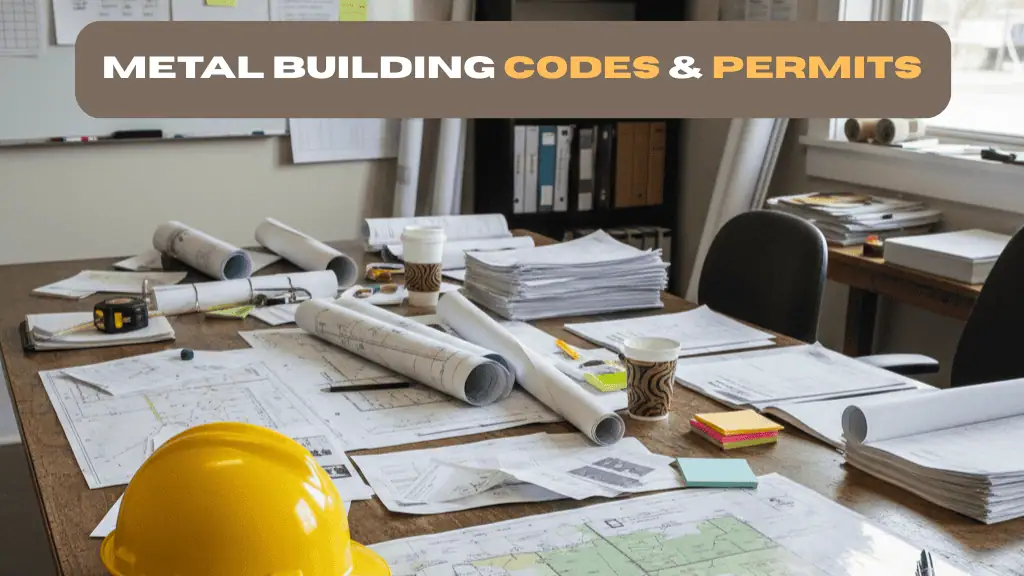
If you’re planning to purchase a steel garage for your car or commercial workshop, here is a reality check: it’s not as simple as ordering a building kit online and installing it on the weekend.
Every single steel building must meet local codes. Those rules and inspections are far from just paperwork; they’re the very things that ensure your building is safe, legal, and actually insurable. Ignore them, and you could face stiff fines- or worse, have to tear down what you just finished building.
Let’s break down the essentials before exploring how five states, Texas, Florida, California, North Carolina, and Georgia- handle approvals for these steel structures.
Design Inputs That Shape Your Permit Package
● Soil conditions: Soft clay or sand may call for deeper footings or piers.
● Wind loads: Coastal Florida or the Texas Panhandle can mean 140-170 mph design winds.
● Snow loads: Minimal in the South, but heavier in NC’s mountains.
● Seismic zone: Critical in California, moderate in GA/ NC foothills.
● Use and occupancy: First, consider your building’s purpose. Is it a simple garage, a workshop, or open to the public?
● Accessibility: If the public is involved, you’ll need to factor in ADA requirements- think ramps, wider doors, and proper signage.
● Energy code: if you’re heating or cooling the space, the energy code kicks in, dictating your insulation and roofing.
Don’t forget, your plans need the official stamp from a licensed engineer in your state. They’ll lay it all out: the foundation, how the bolts anchor it down, the steel frame specifics, and all the load math. This is the proof that your building can stand up to whatever your local weather throws at it- high winds, heavy snow, or even earthquakes.
Permit Types You Might Need
● Building (structural)
● Electrical, plumbing, mechanical
● Fire/ life safety or occupancy change
Inspections You Should Plan For
● Foundation inspection
● Framing and steel erection
● Special inspections for welding/ bolting in seismic or HVHZ zones
● Rough-in for utilities
● Final inspection for Certificate of Occupancy
Keep everything on file: sealed drawings, mill certificates, weld test reports, and inspection approvals will likely come in handy.

Texas is home to big skies and even bigger weather events. That’s why building officials here take regulating buildings seriously. Below, we’ll break down some of Texas’ building standards:
● Code adoption varies. Houston, Dallas, and Austin follow IBC/IRC codes; rural counties may have minimal enforcement.
● Windstorm program. Coastal counties require engineer certification for insurance.
● Soils matter. Expansive clay in Dallas/Houston demands special foundation design.
● Permits & inspections. In cities, expect a full plan review. Some rural counties may only check foundations or skip building permits altogether.
Even if a permit isn’t technically required, always build to code as insurance companies will certainly ask. And always call your county office first. In Texas, these requirements can change dramatically from one jurisdiction to the next.

With severe coastal weather, extreme heat, and the looming threat of hurricanes and tropical storms, Florida buildings are engineered with wind in mind. Let’s look at some of this state’s building code standards:
● Statewide Florida Building Code (FBC). Updated every three years, mandatory everywhere.
● High winds rule. 140–170+ mph design speeds; Miami-Dade and Broward have stricter HVHZ standards.
● Engineer seal required. No stamped plans, no permit.
● Inspections. Foundation, framing, hurricane tie-downs, product approvals, and floodplain compliance in FEMA zones.
Pro tip: Have all Florida Product Approval paperwork ready, inspectors will ask.

With high seismic activity, wild fires, and violent storms, California buildings must be ready for almost any challenge above and below:
● California Building Code (CBC). Based on IBC with seismic and energy amendments.
● Seismic detailing. AISC 341 ductile frames, oversized anchor bolts, and special connections.
● Plan submittal. Often 20-30 sheets including structural, accessibility, CALGreen, and energy checklists.
● Special inspections. Certified inspectors must witness welding, high-strength bolting, and concrete tests.
● Engineer observation. Final sign-off letter is often required.
Pro tip: A local California engineer familiar with seismic detailing and local reviewers can save weeks of corrections.

Even regions with moderate climates must be ready for potential severe natural events. North Carolina residents design their buildings accordingly:
● NC State Building Code. Based on IBC/IRC, enforced statewide.
● Design criteria. Coastal wind (130-150 mph), mountain snow (10-20 psf), moderate seismic in foothills.
● Engineer seal. Required for most commercial projects or anything over 2,500 sq. ft.
● Permit process. County inspections plus fire marshal review for commercial projects.
● Inspections. Foundation, slab, steel framing, trades, and final.
Pro tip: NC inspectors are practical. Minor issues are often resolved quickly with engineer letters.

Georgia is no stranger to high winds and volatile weather, and their codes are made for it. Let’s look at some of Georgia’s building code standards:
● Georgia State Minimum Standard Codes. Based on IBC with amendments, mandatory statewide.
● Design criteria. Coastal winds (120-140 mph), low seismic, minor snow in north GA.
● Engineer stamp. Required for most non-residential or larger structures.
● Permit process. County/city review; large projects may involve the state fire marshal.
● Inspections. Footings, slab, framing, trades, and verification of anchor bolts and rated components.
Pro tip: Watch Georgia’s humidity- uninsulated roofs can cause “indoor rain” from condensation.
Steel buildings only perform as well as the permits and inspections behind them. Each state has its own quirks:
● Texas: patchwork enforcement, engineer stamps still key.
● Florida: fortress-level hurricane standards.
● California: seismic detailing and special inspections.
● North Carolina: consistent enforcement with common-sense flexibility.
● Georgia: uniform codes, with special attention to wind and moisture.
With your plans sealed, inspections on time, and records organized, you’ll sidestep surprises and create a structure that’s not only safe and compliant but also built to last. Ultimately, you’ll have a building you can stand under with complete confidence that your inspector will approve without any second thoughts.
It is fast and easy. Get your instant quote today!